

by Jim Slining
The ALHFAM FARM Professional Interest Group (PIG) is launching a multi-year initiative to fulfill the operative phrase of the ALHFAM mission statement: Sharing practical knowledge and skills. Besides a lineup of workshops and sessions for the annual conferences, we are launching Farmers Bootcamps at ALHFAM sites across the country that use the “ALL IN” approach to learning–fully
engaged and fully doing. The first workshop of 2026 will be focused on plowing and will be held at Island Farm in Manteo, NC, March 14-15. Although this workshop is open only to ALHFAM members, it’s easy to join! Go to https://alhfam.org/join-us, select a membership category and join, and then go to the workshop registration page at https://alhfam.org/event-6430166?CalendarViewType=1&SelectedDate=3/28/2026 to sign up.
While in college, I worked in the university’s flight simulation department. Pilots begin by carefully reading a flight manual. In-depth study of procedures can go far in knowing about flying a plane, but only physical practice enables knowing “how”. Economic demands have incentivized efforts to ensure simulators accurately replicate each detail (the look, smell, feel, sound) of flight. These many details are required to tell the full story of an aircraft’s disposition; information required for a pilot to work in a safe and efficient manner. A false cue in the simulator can create misinterpretations detrimental in actual flight. Simulators can also be used as laboratories, allowing various hypotheses to be objectively evaluated in ways not otherwise possible.
Jay Anderson defined living history as the “simulation of life in other times.” Just as in the simulation of flight, living history allows us the ability to understand more about the how of another culture, aspects not achievable through documentary or object study alone. Like much of the common life we attempt to simulate at our sites, the attributes of a bicycle would be difficult to accurately present without practiced, intuitive skills. Imagine encountering a bike for the first time. Recognized as a conveyance, with attempts to use it ending in repeated wrecks, it might easily be labeled as an awkward, unsophisticated liability. Just then, someone rides up at great speed, expertly maneuvering around obstacles while reading a book. The bike’s potential is exposed only when practiced skill is added to the equation.
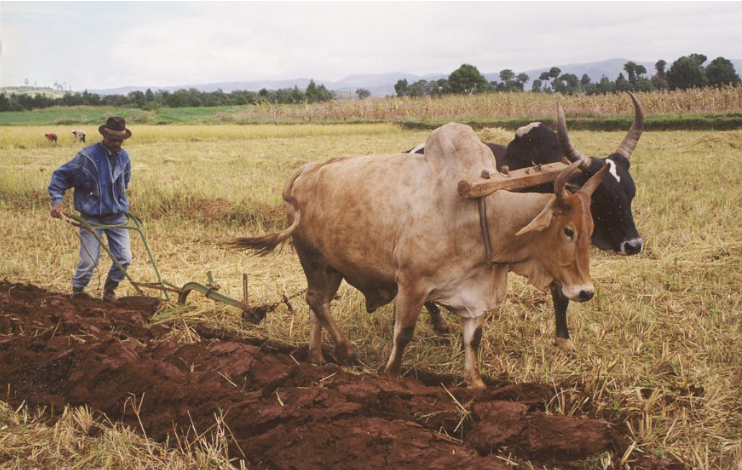
Impeccable rote skill displayed by oxen and teamster alike: Justine and team use voice commands to plow laser-straight furrows in Madagascar. Photo by Richard Roosenberg
I call this “rote” skill. Not mere “muscle memory,” the mind and body function together cognitively, in this case to identify and avoid obstructions. Rote skills change our assessment of the bike’s value by encouraging a broader, more complex contextual perspective. What was once viewed as awkward becomes brilliant. We can now appreciate the bike’s many (design and power) efficiencies. As skills induce confidence to ride at greater speeds, balance becomes easier, ironically reducing attention to those very skills. The subconscious nature of rote skills allows them to recede into the background, unnoticed and difficult to describe.
A former Master of Colonial Williamsburg’s Cabinet Shop wrote “In a craftsman’s training, the surfacing of materials by hand cultivates [my emphasis] his visual judgement of flat and square. It prepares the workman to adjust to varying situations, and to execute successful details with maximum speed and a minimum of measurement.” Note the careful selection of the word “cultivates.” The “judgement” described – the ability to determine flat, square and true without focusing on it – is a rote skill. Beginning with dimensional lumber (as do many hand-tool woodworkers today) disallows the possibility to cultivate the basic attributes of pre-industrial woodwork. To be cultivated in historical work–to attain comparable rote skill to that of our subject–one must learn skills in an historical manner. Inaccurate tooling, shop furnishings or finished work will – like false cues in a flight simulator – result in false understandings and impressions that impede a contextual assessment of the past.
I do not need to emphasize to this audience the importance of public history or the imperative for accurate programming. We recognize it is rote skills that enable masterful violinists to accurately interpret music “heard” within through the strings. We would never confuse the “rustic” sound of a beginning violinist as a representation useful for critique. We would not confuse it because the skills necessary to truthfully demonstrate the violin’s potential have been preserved in continuous use. Though scholars are careful to accurately document history when placed in written form, ignorance encourages disregard for the requirement of rote skills to accurately represent the common culture of historical life; we don’t know the difference, and we believe our guests won’t either. The result is the dull, fumbling misrepresentation of another culture and missed opportunity for insight. Simulating everyday life flushes out contextual questions which catalyze research; of all the possible choices, why this way? For forty years I have watched the number of administrative positions at our sites swell and program development reduced to “talking points,” resource allocations not directly conducive to living history.
Our inherited industrial minds emphasize the values of the corporation (the dualistic separation of mind/manager from body/practitioner) over the attitudes and abilities necessary to simulate the past. Inherent to the agrarian paradigm of pre-industrial life is the requirement to employ the synergy of hand and mind in the acquisition of rote skills. If living history is to fulfill long-anticipated expectations, it must become less conventional and begin to esteem practical skills in practical ways. Rote skills are the crux of ALHFAM’s mission statement. Historical cultures–and many of the cultures we share the world with–cannot be understood without them.
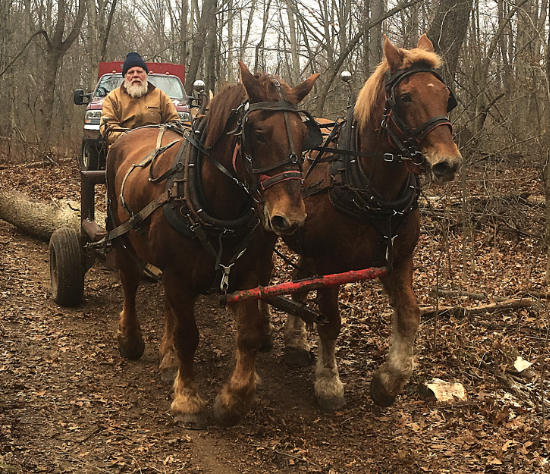
Sampson, Solomon and Jim share a fall day together skidding logs. Photo by Jehra Smith
Jim Slining has spent a lifetime seeking technology requiring intuitive skills. When younger, he worked as a printer, pilot and audio engineer. Later his focus turned to historical skills. In all of these, Jim has had the good fortune to work with individuals who revealed the art of technically sound craftsmanship. The overarching attraction continues to be the stewardship and egalitarian agency available through simple tools when thoughtfully used, and the beauty possible when resilient common culture is allowed time to organically develop around the sensibilities of a given place.

 ALHFAM
Thought provoking and true!
Ed Schultz
Master Historic Farmer
Historic Trades and Skills Department
Colonial Williamsburg Foundation