

“From the President’s Pen”
Winter weather to date has this year has been unpredictable and challenging for much of the ALHFAMily. Much of the New England, Mid-Western, Mid-Atlantic and Southeastern regions of the United States have been buried by snow, ice, and/or enveloped by a three- week “polar vortex” unseen for many years. But most likely, this is just an ordinary winter for our Canadian and Northern European members. Meanwhile, states in the Mountain Plains and Western United States are experiencing drought and unseasonably warm temperatures. While I scrabbled to find enough seasoned firewood to feed the woodstove during subzero nights, several family members in Colorado played golf on sunny, 60-degree days in Denver. We long for the sun’s warmth and the return of color to the monochromatic white and gray landscape, awaiting the lavender burst of the first crocus or glimpse of a reddish-orange robin’s breast.
Weather shaped the lives and events of those from the past whom we interpret through living history. Daily weather journals and almanacs with meticulous detail provided crucial information on when to plant, cultivate, and harvest gardens and crops, and properly care for small animals and livestock. Today, these historic records of weather cycles provide the basis for many of our agriculture and farm-based interpretive activities and public programs. Impacts of a warming planet in recent decades have made this practice increasingly challenging. This year, the return of historic cold and snow patterns in some regions witnessed a rebirth in programs such as ice harvesting, sledding, skating and sleighing, butchering and meat preservation. I’m excited about this opportunity, however brief it may be, for a new generation of visitors to gain hands-on experience with the skills and tools needed by past generations to adapt and prosper during wintertime conditions we see today as only inconvenient.
Winter also plays a vital role in maintaining the health and balance of our ecosystems, serving as a period of hibernation, rest and renewal lifecycles for flora and fauna. Farmers and agriculturalists have known this for centuries. Naturalist colleagues remind me there is an intricate web of animals and plants thriving below the snowpack that depends upon the snow’s protection from the bitter cold. This is a perfect metaphor on the value and opportunity wintertime provides for living history programming to also thrive. Winter programming provides a wonderful opportunity to attract visitors as they seek authentic experiences closer to home, while having fewer daily demands and pressures than during warmer months. The return of “real winter” reminds us that wintertime could and should be just as important as the other seasons of the year for engaging the public in the work that we do.
2026 continues to bring struggle and heartache for the history community. At the very time the commemoration of the United States’ founding as a nation 250 years ago begins, we find the inclusive, fact-based interpretation of these past 250 years under siege and censorship. Unprecedented efforts are underway by the United States federal government to “sanitize” the country’s origin story by removing difficult, complicated stories from exhibits and interpretive/educational programs at federally-owned and -managed museums, historic sites and parks. The intentional removal of exhibit panels portraying nine persons enslaved at George Washington’s ca. 1790 – 1797 “President’s House” historic site in Philadelphia, along with the removal of dozens of interpretive panels in national parks with content related to the mistreatment of Native Americans during European colonization, are high profile examples. Creating false, disingenuously nostalgic views of the past could undo decades of tremendous progress in social history by organizations like ALHFAM. ALHFAM stands in strong solidarity with all our colleagues and friends negatively affected by any of these efforts currently underway by the United State federal government, or other organizations. We strongly support the efforts of our organizational partners, including AASLH and AAM, in reversing and correcting these recent transgressions.
ALHFAM stands firmly committed to ensuring the accurate, holistic and inclusive preservation and interpretation of the past. These values are the pillars upon which ALHFAM is built. In this spirit, the ALHFAM Board of Directors (BOD) held a very productive fall meeting in Dearborn, Michigan this past November. A new 3-year strategic plan was drafted that sets forth bold, tangible and aspirational organizational goals. These range from providing greater accessibility of services and knowledge to members and potential future members, to better positioning ALHFAM as the leader in diverse living history interpretation and advancing financial growth for long term sustainability. The draft version of these goals will be shared with the membership on our website later this spring.
During our fall meeting, the BOD also benefited from a full day and a half of professional development by The Slave Dwelling Project. The organization’sfounder, Joe McGill, and Slave Dwelling Project Board member Nicole Moore guided us through sessions and exercises to ground ourselves in being open and honest while we worked through a strategic planning session to envision the future of living history by 2029 and 2034. This training helped the BOD better understand its role in leading the organization, while examining the importance of living history interpretation as a vehicle for uplifting African Americans and other underrepresented voices.
I continue to find strength during these incredibly challenging times in our organization’s commitment in bringing the past fully to life, “warts and all,” to quote a presenter at a recent 250th planning conference. ALHFAM is intentional in ensuring all voices who shaped the past are heard. I was also recently inspired by the major role living history (historic sites & outdoor museums, and military and civilian costumed portrayals, in particular) played in the success of Ken Burns’ and Sarah Botstein’s 12-hour landmark series, The American Revolution. The production team noted repeatedly in the pre-release screenings and lectures I attended on how crucial living history/reenacting was for the visual texture and authenticity of the eighteenth century that was needed. AI is a useful tool but can never replicate the authenticity and impact of costumed living history. Florentine Films had rarely used living history in previous productions. Since photography did not exist in the eighteenth century, many paintings of this period were often highly romanticized, so living history entered to fill the void. Many ALHFAM members participated as individual museum professionals or in organizational support roles for this production. Freeze-frame the credit list at the end of an episode to see our profound member contributions. This production would have been a far different experience for its millions of viewers without us.
This winter, current geopolitical, military, economic and social upheavals worldwide have impacted all of us in different ways. While unbearable at times, experiencing these in real-time gives us insight on how those in the past coped with similar impacts on their daily lives and how they survived, adapted and endured through hardships which seemed unimaginable. This insight can have a positive benefit to our work as living history practitioners as we draw connections between past and present current events. We are living in difficult and uncharted waters, not knowing the future. The lyrics in singer-songwriter Jelly Roll’s song, “I Am Not Okay” captures our current mood, especially in the song’s refrain, “I’m not okay, But it’s all gonna be alright… It’s not okay, But we’re all gonna be alright.” Despite the challenges, ALHFAM’s light continues to shine brightly and is very much alright. May the springtime regeneration of plants and animals bring a rebirth of hope, justice and happiness to all.
By Mark Texel, ALHFAM President
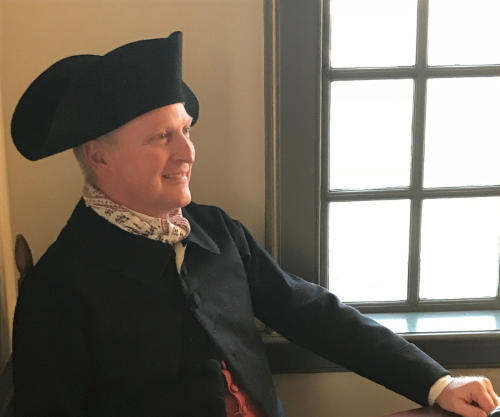
Mark has worked professionally in historic sites, living history/outdoor museums and public parks since 1988. He holds B.A.’s in American History and American Music, and a Certificate in Historic Preservation from Drew University. Currently administrator for the New Jersey Office of Historic Sites, Mark is responsible for stewardship of over 50 state historic/cultural sites and guides the work of 20+ history professionals and 24 nonprofit partners. He previously served as director of the New Jersey State Park Service (including its Office of Historic Sites) from 2012 – 2021. He became the president of the Association for Living History, Farm and Agricultural Museums in June 2025. He has portrayed both civilian and military as a member of progressive living history units and is active with the New Jersey Living History Advisory Council. Mark is directing the overall visitor readiness preparation, including capital and programmatic planning, of New Jersey’s state historic sites for the Semiquincentennial commemoration in 2026.

 ALHFAM
Brilliant message, Mark!