
by Nancy Kimberley Phillips
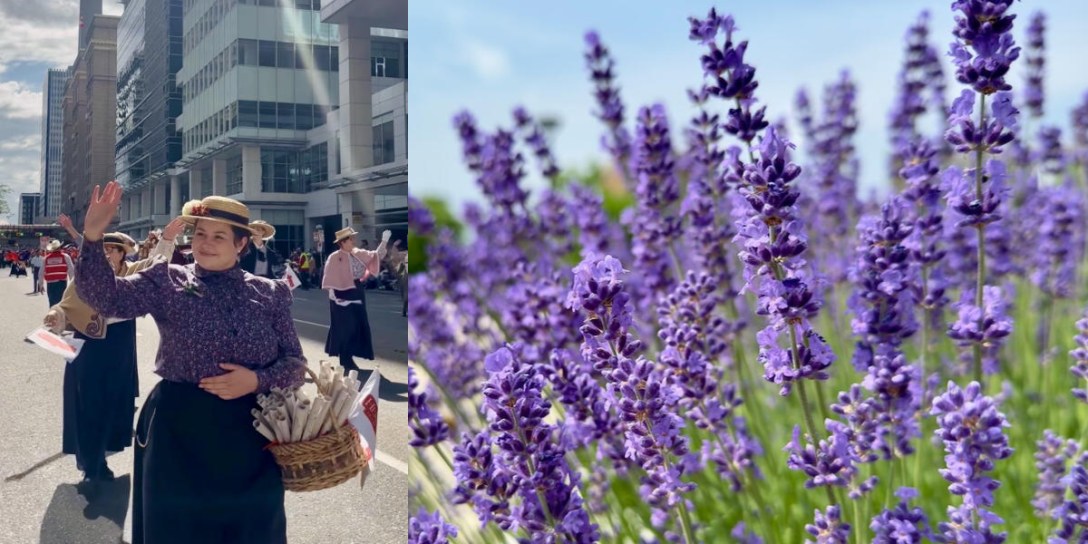
Heritage Park is a large living history museum in Calgary, Alberta (Treaty 7[1]) that has been in operation since 1964. The primary focus of the Park is to share the history of Western Canada between ~1880-1940. In recent years, a central part of our mandate has been to diversify the stories that we share in order to better connect with our communities. I first started work at Heritage Park Historical Village in 2022 as the Public Programming Specialist of Resource & Trades with the Programming & Experiences department. As a Queer person in a supervisory role, I am always searching for ways to better support and celebrate LGBTQ2+[2] people, history, narratives and communities at the Park.
In 2023, one of our interpreters approached me and asked if they could wear a lavender sprig on their costume lapel to signal that they were part of the LGBTQ2+ community. During the Victorian Era, floriography (a way of communicating through cryptic flower messages) was popular, including among the LGBTQ2+ community. Wenzhe Li, a scholar in art history and Queer theory, writes that “some flowers, such as violets, pansies, and lavender, are considered the symbols of LGBTQ+ culture.” Violets were popularized by the writings of Sappho (c. 630-570) to symbolize specifically women-loving-women relationships. Pansies were most popular in the 1920s-30s and were also used as a term for homosexual men. Oscar Wilde became known for the use of green carnations in 1892 when he instructed his friends to wear them on their lapels as a symbol for men-loving-men.
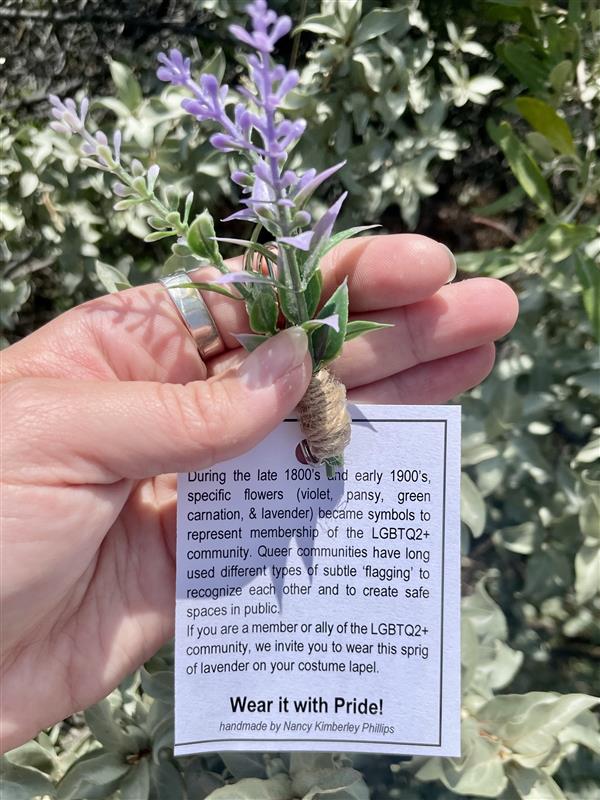
Finally, lavender has been used since the 1920s as a catch-all term and symbol for all Queer individuals – it is most well-known for things like the “Lavender Menace” and the “Lavender Scare” in the 1950s. The wearing of these specific flowers can act as a form of “flagging”, a subtle method that Queer individuals have used to communicate, recognize each other and work to create safe spaces in public.
At Heritage Park, all public-facing roles wear a period-appropriate historic costume that is hand-made specifically for their area, site and role. The wearing of lavender on costume lapels fits thematically and historically with the rest of the Park; it is a tool for interpretation, and it is a way of making period-appropriate Pride pins available for the staff who want them. While it is true that people in small-town Alberta may not have historically worn these Queer flowers, being at a living history museum allows us to weave together narratives in meaningful ways that will speak to our communities in 2025. After writing a proposal and getting the necessary approvals, I initially created 80 pins made of faux lavender, a large clothing pin, wire, and twine. We attached small write-ups to each pin that explained the history and the purpose of this project, so that people could self-select if they wanted to participate.
All of the pins from the first batch were taken within a week!
Interpreters remarked to me that “I have been waiting years for something like this” and that they felt supported and seen by this mandate. I’ve also seen other departmental staff whom I’ve never met before wearing them proudly on their costume. Needless to say, the project has been a huge success! I am currently in the process of making 120+ more pins, and I am hopeful that this project will continue as an easy, meaningful, historic way of representing the LGBTQ2+ community at our living history museum.
[1] Treaty 7 is the traditional homelands of the Niitsíítapi/Blackfoot Nations (Siksiká, Káínai, and Piikáni); the Îyârhe Nakoda Nations (Chiniki, Bearspaw, and Goodstoney); the Tsuut’ina Nation; and the Métis Nation
[2] LGBTQ2+ means Lesbian, Gay Bisexual, Transgender, Queer, Two-Spirit and others.
References
Li, Wenzhe. Queer Flowers: Queer Erotics, Mourning, and Utopias in the Art of Flowers from the 1920s to the 1980s. University of Hull (2023).
Prager, Sarah. Four Flowering Plants That Have Been Decidedly Queer. JSTOR Daily (2020). https://daily.jstor.org/four-flowering-plants-decidedly-queered/
Willingham, AJ. The Secret Queer History of Flowers. CNN (2023). https://www.cnn.com/2023/06/25/us/flowers-lgbtq-lavender-meaning-cec
Biography
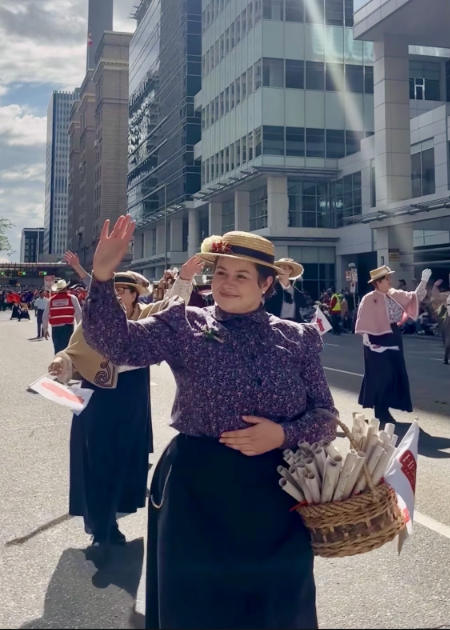
Nancy Kimberley Phillips (ihtsiiyiaakíí) is a Queer Settler from Mohkínstsis (Calgary, Alberta – Treaty 7). With a Master of Arts degree in Museum Anthropology from the University of British Columbia, Nancy has worked in environmental, museum and historical education for the past ten years. She currently works at Heritage Park Historical Village as the Public Programming Specialist of Resources & Trades.

 ALHFAM