

Spring has sprung all over the world. Flowering trees, shrubs, grasses and plants of every imagination put forth a cornucopia of color to attract pollinators to set their fruit and seed. Songbirds sing cheerful melodies to attract mates, while the lambing and farrowing season brings newborns to our farm and agricultural museums. The happy chatter of hundreds, if not thousands, of school age youth fills the air of our historic and cultural sites, living history museums and the performance spaces of our independent museum professionals. The natural world’s post-winter reawakening brings hope that despite all the challenges in the world, Mother Earth renews herself and continues to nourish us. Attending various Earth Week activities during the week of April 20th reminded me of how interconnected we are with our planet. As an organization with deep roots (no pun intended) in preserving and interpreting humanity’s agricultural connections with the Earth, ALHFAM stands at the vanguard of bringing these relationships to life.
Spring of 2026 also brings a blossoming of publications, social media articles & podcasts, educational and interpretive programs and special events commemorating the Semiquincentennial of the founding of the United States of America in 1776, aka “The 250th”. Following years of careful research and planning, these historic events and their stories take center stage in the work of many individual and organizational ALHFAM members. High quality living history interpretation will be prominent throughout the 250th anniversary timeline that began in 2025 and will continue in some parts of the United States and the world through 2033. The “revolutionary ideals and events” unfolding in 1770s Colonial America also profoundly shaped the history of Canada, Europe and beyond, making the 250th an opportunity to tell a global story.
The excitement for the 250th is tempered by the sobering reality of the ongoing difficult, and often painful, events occurring in real time running counter to the principles of “All men (people) are created equal.” How do we reconcile celebrating the revolutionary messages within the uplifting sections of the Declaration of Independence, with the reality these same ideals are still not fully realized and in some cases appear under assault? Almost 200 years passed following the signing of the Declaration of Independence before indigenous peoples, women and people of color in the United States gained the same rights of self-determination, liberty and participation in government which only a select and privileged group of individuals enjoyed at the time of the United States’ founding.
We the People of ALHFAM remain committed to inclusive, meaningful and truthful storytelling throughout the 250th, even when the truth is painful and heartbreaking. So too, are major history-based partner organizations, including the American Association for State and Local History (AASLH). AASLH President and CEO John Dichtl provides a roadmap in his April “250th and Beyond” message for helping navigate the 250th moment, giving history organizations reason for hope on the merits of staying committed to accessible, meaningful and inspiring work. One of his key points is using the 250th moment to bridge divisions through a very broad interpretation of the past, rather than a narrow one.
The 250th should be a time of commemoration for everyone and be deeply rooted in local and community organizations. This is indeed what is transpiring across the United States at the most grassroots level. America250 (the initiative led by the bipartisan, Congressionally-established U.S Semiquincentennial Commissison) is rolling out many programs aimed at “honoring the contributions of all Americans” and will largely occur in local communities.
As historians, we also have an obligation to document how we interpret and commemorate the 250th to provide a useful tool for future generations planning similar events 50 and 100 years from now. Professor of American History Heather Cox Richardson is doing just this, in part through her Letters from an American series, a nightly podcast that chronicles current events within the larger context of American and world history.
There is no better way to become immersed in the 250th stories and history than by attending our 2026 ALHFAM Annual Meeting and Conference in Dearborn, Michigan, June 16 – 21. The conference planning committee has curated an inspiring and splendidly diverse program of workshops, tours, sessions and speakers revolving around the theme of Community, Conflict, Conversation. This theme encourages us to examine community and conflict in ways which help living history practitioners engage in conversations that facilitate learning and lead to understanding and healing. The clairvoyance in choosing this theme several years ago is astounding, given geopolitical events worldwide happening in real time, in addition to the 250th. There is still time to register for the full conference, for just one day, or for the virtual option that includes a select number of sessions and speakers. Please spread the word far and wide with friends, colleagues and like-minded practitioners of living history who may not be members of ALHFAM and are unaware of this amazing learning opportunity. Please visit the conference website and get registered!
ALHFAM offers another option for immersion when it hosts our first international regional conference September 23 – 26, 2026 in Reykjavik, Iceland. The theme of this conference – Food for Thought: Bridging Cultures Across Time – invites us to reflect on how knowledge, traditions and skills move between communities and across generations. The call for proposals for this regional conference has been extended until May 15,2026; the link to the form is on the conference page on the ALHFAM website.
The ALHFAM Board of Directors holds its 1.5 day in-person board meeting at the Student Center of Eastern Michigan University June 15 – 16, just prior to the start of the Annual Conference. This is an exciting time as we welcome three newly elected Directors to the ALHFAM Board, along with a new Secretary. It will also be a bittersweet moment as we thank the work of three very dedicated Directors whose terms end following the conclusion of the business meeting during the Annual Conference. We will also refine our 3-year strategic plan with emphasis on growing and diversifying our membership, public outreach, access and support to our membership. I’m thrilled about the opportunity to spend time with the ALHFAMily in just a few weeks, during our Annual Meeting and Conference in Michigan. Until then, make time in your incredibly busy schedules this spring to reconnect with the Earth not only for its nurturing and healing benefits but also for what it, and especially its plant kingdom, can teach us. Author Robin Wall Kimmerer reminds us in her national bestselling book Braiding Sweetgrass: Indigenous Wisdom, Scientific Knowledge, and the Teachings of Plants, that “the plants can tell us their story…we just need to learn to listen.” Wishing all good health and spirits during the renewal of springtime.
By Mark Texel, ALHFAM President
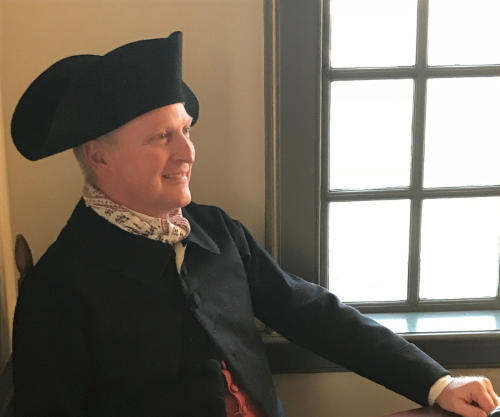
Mark has worked professionally in historic sites, living history/outdoor museums and public parks since 1988. He holds B.A.’s in American History and American Music, and a Certificate in Historic Preservation from Drew University. Currently administrator for the New Jersey Office of Historic Sites, Mark is responsible for stewardship of over 50 state historic/cultural sites and guides the work of 20+ history professionals and 24 nonprofit partners. He previously served as director of the New Jersey State Park Service (including its Office of Historic Sites) from 2012 – 2021. He became the president of the Association for Living History, Farm and Agricultural Museums in June 2025. He has portrayed both civilian and military as a member of progressive living history units and is active with the New Jersey Living History Advisory Council. Mark is directing the overall visitor readiness preparation, including capital and programmatic planning, of New Jersey’s state historic sites for the Semiquincentennial commemoration in 2026.

 ALHFAM