
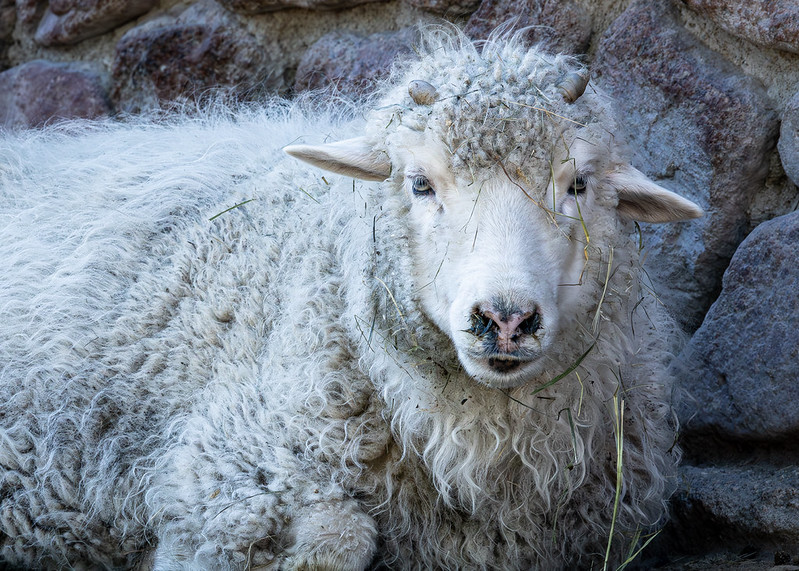
“Now the meadows and pastures were velvety with thick grass, and the weather was warm. It was time to shear sheep.” – Farmer Boy by Laura Ingalls Wilder
As we draw nearer to summer, the sheep at Rock Ledge Ranch are looking more and more ready to be sheared. Like Almanzo and his family in Farmer Boy, we all look forward to Shearing Day each year.
At Rock Ledge Ranch Historic Site at Garden of the Gods Park in Colorado Springs, Colorado, our woolly friends get their yearly haircut on the first Saturday in June. Throughout history, the timing of shearing has depended on the breed of sheep, the weather and other conditions on the farm. By early June at the Ranch, we are usually through the late spring snowstorms, and the sheep are ready to be rid of their heavy wool coats. Once freed from a heavy layer of wool, the sheep run out into the pasture to enjoy the fresh green grass without their encumbering winter weight. The lanolin their bodies produce protects their skin from sun damage, even if they turn a little pink after their first afternoon out without wool.
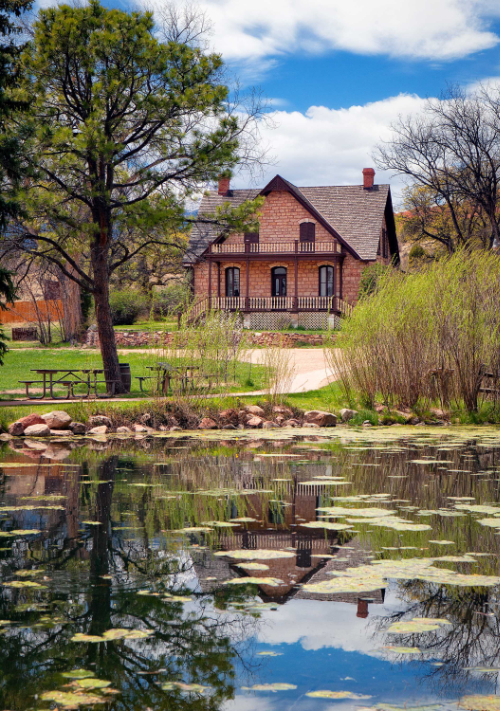
The Rock Ledge House, built in 1875, and the pond at Rock Ledge Ranch
Rock Ledge Ranch is currently home to ten sheep, who share a pen with Martha the Jersey cow and the chickens in the barnyard. There are five different breeds represented.
Charlotte, who came to the Ranch as a lamb seven years ago, is a Dorset sheep. Dorsets come from England, and most historians think they were originally a cross between Merino sheep and Horned Sheep of Wales. They are a desirable breed of sheep because their fibers are strong and long, and their fleeces can weigh from five to nine pounds.
The smallest sheep in our flock is an Icelandic, jokingly referred to as “Thing One.” Icelandic sheep are unique because their wool grows in two distinct layers. The inner layer, called the Thel, is soft and springy, while the outer layer, the Tog, is coarser and wavy, helping to protect the sheep’s inner wool and skin. This makes the cleaning, carding and spinning of Icelandic wool more difficult, though it makes a sturdy and weather-hardy yarn when spun.
Sneakers is the largest sheep at the Ranch and has been on site since 2016, when Junior Docents enjoyed taking him on walks around the property. One former Junior Docent fondly refers to this experience as “walking the lawnmowers.” No longer a little lamb, this Rambouillet-Scottish Blackface sheep can be identified by his horns and black spots on his face.
Four male Cheviot sheep joined the Ranch flock just a few years ago. Cheviots are a very old breed originating in England, both hardy and energetic. They are distinct from the other Ranch sheep in that no wool grows on their heads or legs. Cheviot wool is sought after for its long fibers and curly texture, which add strength, softness and springiness to anything produced from it.
Three Navajo Churro lambs round out the Ranch flock: Cinnamon, Sugar, and Pepper. The Spanish brought Churra (which later morphed to Churro) sheep to the Americas in the 16th century. Within another hundred years, the Diné (as Navajo people call themselves) who lived on the outskirts of Spanish settlements acquired the Churro sheep from the Spanish and began to grow their herds on their traditional homelands. These Navajo-Churro sheep became extremely important to many Navajo people’s lives, providing self-sufficiency in food and clothing, as well as a valuable commodity to trade. Navajo-Churro sheep come in many colors, and their wool is low in lanolin, making processing the wool swifter and easier. Their meat is low in fat, but their milk is high in cream, making them a very valuable and desirable animal for food as well. The breed is hardy, resistant to disease and protective of their young. U.S. government actions against the Navajo people in the past often threatened the survival of this breed of sheep, but the Navajo always succeeded in keeping some of their herds alive, preserving this first New World breed of sheep. These three young sheep have joined the Ranch within the last year, and this was their first shearing at Rock Ledge Ranch.
Although they may not enjoy the brief confinement of being sheared, the removal of their heavy wool fleeces every year is essential to the health of sheep. They bound away afterwards much lighter and more comfortable! For we humans, that’s when the work really starts: cleaning, carding, spinning, knitting, weaving, crocheting, felting and more! At Rock Ledge Ranch Historic Site, this is our opening event of the summer. On Saturday June 6, 2026, crowds of people joined us to see the sheep sheared—and more wool-related demonstrations—at our Sheep Shearing and Fiber Arts Day at Rock Ledge Ranch Historic Site. We hope you’ll join us next June!
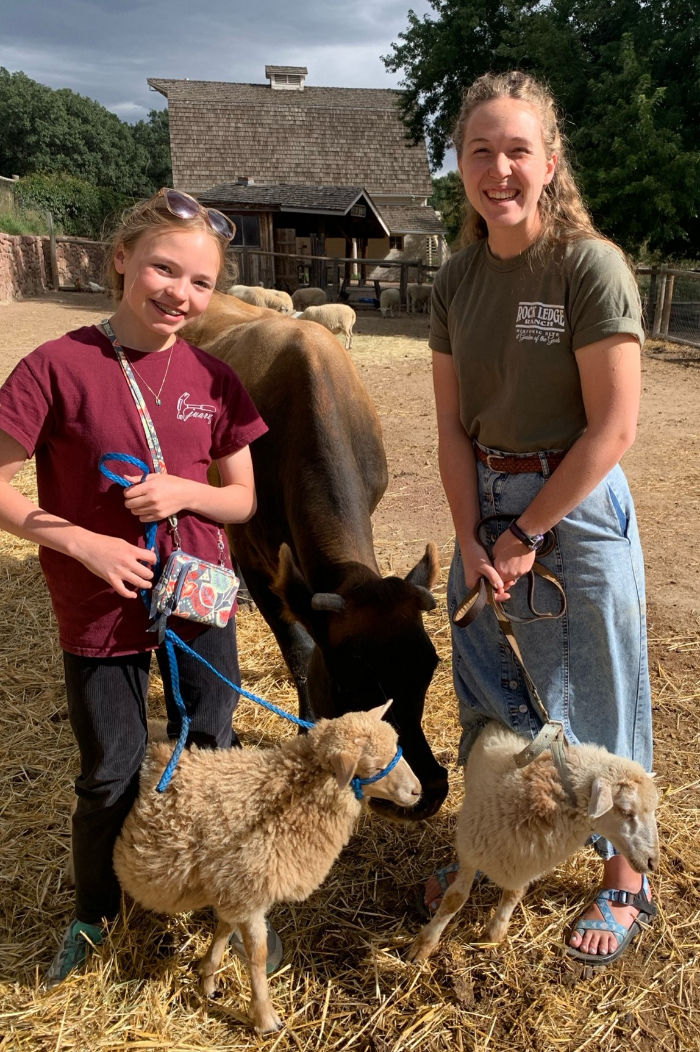
Elizabeth Smyth has been sharing the stories of Rock Ledge Ranch since 2012 as a historical interpreter, educator, and author of The Stories the Stones Might Tell. She lives with her husband in Boerne, Texas, thinking and writing about Rock Ledge Ranch as often as she can.
Photo: Author Elizabeth Smyth and a Junior Docent with the Rock Ledge Ranch Navajo Churro sheep – Cinnamon and Sugar, and Martha the Jersey cow.


